
One of the greatest Western films ever made, The Good, the Bad and the Ugly (1966) is an iconic Italian Spaghetti Western that continues to captivate film lovers around the world. Featuring gunslingers, horseback riders, outlaws, the American Civil War, revenge and a desperate search for buried gold, the film remains a landmark in the history of cinema.
Directed by Sergio Leone, the film stars Clint Eastwood, Lee Van Cleef and Eli Wallach in the leading roles. The unforgettable background score by Ennio Morricone played a major role in making the film internationally famous.
The Background: The American Civil War
The story unfolds against the backdrop of the American Civil War (1861–1865), a period marked by violence, destruction and uncertainty across the United States.
The war has devastated several regions, leaving soldiers, outlaws and ordinary people struggling to survive. Against this turbulent background, a secret about a large quantity of buried gold brings three very different gunslingers together.
Their common objective is to find the hidden treasure, but their personalities, ambitions and methods make their journey extremely dangerous.
Three Different Personalities: The Main Characters.
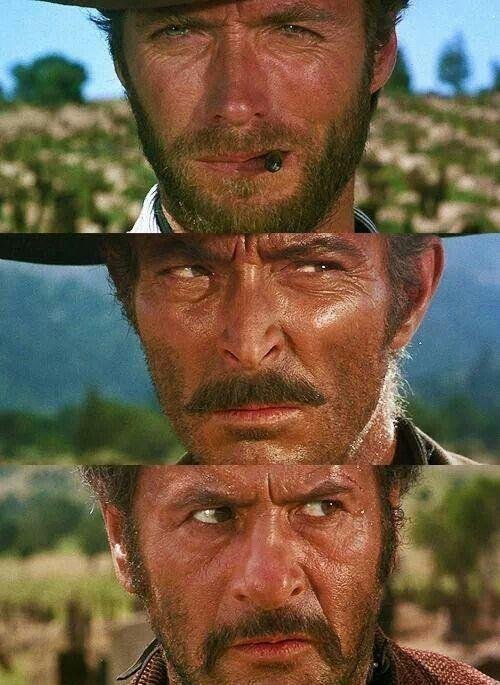
1. The Good – Blondie
Clint Eastwood plays Blondie, a mysterious, calm and highly skilled gunslinger who rarely speaks more than necessary. He is intelligent, patient and exceptionally accurate with his revolver.
Although he is interested in making money and often uses clever strategies to achieve his goals, he displays more humanity than the other two characters.
2. The Bad – Angel Eyes
Lee Van Cleef portrays Angel Eyes, a ruthless professional gunman who works for money and has little hesitation about killing anyone who stands in his way.
He is calculating, merciless and determined to obtain the hidden gold. His willingness to use violence makes him the principal antagonist of the story.
3. The Ugly – Tuco
Eli Wallach plays Tuco, a Mexican outlaw who is clever, talkative, unpredictable and constantly involved in dangerous situations.
He is a wanted criminal who uses his intelligence and survival instincts to escape difficult circumstances. Despite his greed and dishonesty, Tuco also displays humour, emotion and a complicated human side.
A Dangerous Partnership: Deception and the Search for Gold
At the beginning of the film, Blondie and Tuco work together using an unusual trick. Tuco is presented as a wanted criminal and handed over to the authorities, allowing Blondie to collect the reward money.
Just before Tuco is hanged, Blondie shoots the rope from a distance and saves him. They repeat this scheme in different towns, sharing the reward money.
However, their partnership eventually breaks down, and Blondie abandons Tuco in the desert. This creates a bitter conflict between the two.
Meanwhile, the story of a hidden Confederate gold treasure emerges. Approximately $200,000 worth of gold has been concealed in a secret location.
The challenge is that neither Blondie nor Tuco possesses all the information needed to find it. Tuco knows the name of the cemetery where the gold is buried, while Blondie knows the name of the grave containing the treasure.
Realising that they need each other, the two men are forced to continue their dangerous journey together.
An Adventurous Journey Through the Civil War
As they travel in search of the gold, Blondie and Tuco encounter the horrors of the American Civil War.
They witness battles between Union and Confederate soldiers, military prisoner camps, destroyed buildings, suffering civilians and the devastating consequences of war.
The film powerfully portrays the hardships experienced by ordinary people during wartime.
Meanwhile, Angel Eyes is also pursuing the treasure. He eventually captures Blondie and Tuco and attempts to extract information about the hidden gold.
All three men have the same objective, but none of them trusts the others. Greed, deception and survival become the driving forces behind their actions.
The Legendary Final Gunfight in Cinema History
The most memorable sequence takes place towards the end of the film.
All three gunslingers finally arrive at Sad Hill Cemetery, where the treasure is hidden among thousands of graves.
The final confrontation begins.
Who will shoot first? Who will survive? And who will claim the gold?
The three men stand facing one another in a tense standoff. This sequence, often referred to as the three-way duel, is regarded as one of the most iconic gunfight scenes in Western cinema.
The prolonged silence, close-up shots of the characters’ faces, intense expressions and extraordinary background music create an atmosphere of suspense that keeps viewers on the edge of their seats.
Eventually, Blondie uses his intelligence and shooting skills to defeat Angel Eyes. Blondie and Tuco find the gold, but Blondie has one final trick for his companion.
He places a noose around Tuco’s neck and makes him stand on a grave marker. Before riding away, Blondie shoots the rope, leaving Tuco alive but humiliated.
The scene provides a memorable conclusion to their complicated relationship.
Ennio Morricone’s Music: Another Hero of the Film
The success of The Good, the Bad and the Ugly owes much to the extraordinary musical composition of Ennio Morricone.
The film’s distinctive whistling theme, unusual sound effects and dramatic musical arrangements became internationally recognisable.
One of its most famous musical compositions is The Ecstasy of Gold, which accompanies the dramatic search for the treasure.
Director Sergio Leone demonstrated exceptional filmmaking skill by using music, silence, facial expressions and camera movements to communicate emotions and tension, often without relying heavily on dialogue.
Morricone’s music became inseparable from the identity of the film and remains one of the most celebrated soundtracks in cinema history.
Historical and Cinematic Significance
Released in Italy on 23 December 1966, the film later achieved enormous international popularity.
Produced through an international collaboration involving Italy, Spain and West Germany, it became one of the most influential works of the Spaghetti Western genre.
The performances of Eastwood, Van Cleef and Wallach, combined with spectacular desert landscapes, remarkable cinematography, memorable dialogue and outstanding music, helped establish the film as a timeless classic.
It is also the third film in Sergio Leone’s famous Man with No Name Western trilogy. The other two films are:
- A Fistful of Dollars (1964)
- For a Few Dollars More (1965)
Together, these three films helped redefine the Western genre and established Clint Eastwood as one of its most recognisable screen figures.
Conclusion
The Good, the Bad and the Ugly is much more than an ordinary cowboy film. It is a story about human greed, deception, survival, intelligence, betrayal and the struggle for wealth.
The dangerous journey of three men with completely different personalities, united by their desire to find the same treasure, forms the heart of the film.
Its outstanding performances, unforgettable soundtrack, magnificent cinematography and legendary final gunfight have secured its place among the greatest Western films ever made.
Even today, the sound of revolvers echoing across dusty landscapes and the footsteps of horses in the Wild West continue to make this film unforgettable for generations of movie lovers.
Film Information
| Particulars | Details |
|---|---|
| Film title | The Good, the Bad and the Ugly |
| Release year | 1966 |
| Director | Sergio Leone |
| Main actors | Clint Eastwood, Lee Van Cleef, Eli Wallach |
| Music composer | Ennio Morricone |
| Genre | Spaghetti Western |
| Setting | American Civil War period |
| Original Italian release | 23 December 1966 |
| Running time | Approximately 2 hours 41 minutes |
For more details: Navamalayalam.com