
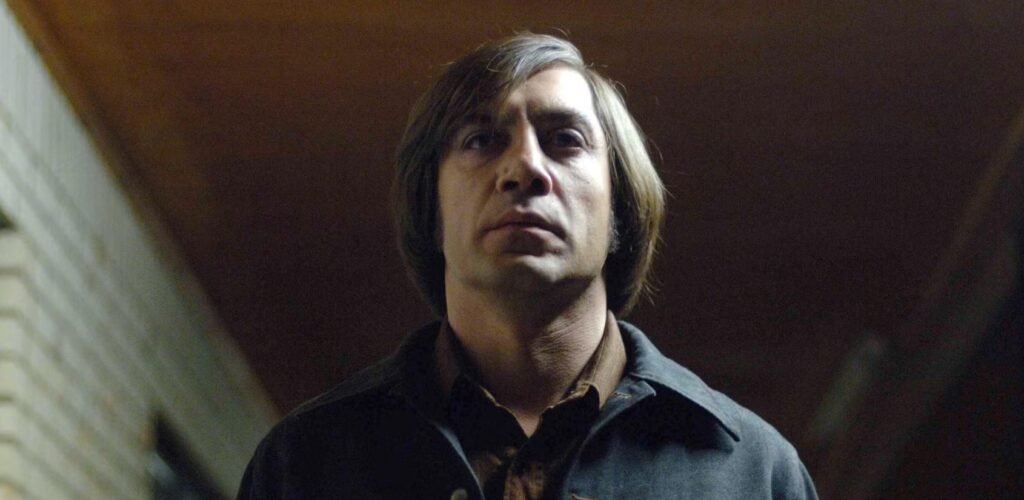
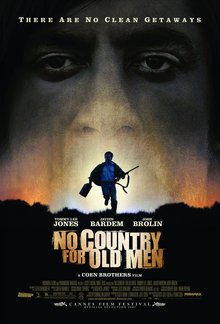
No Country for Old Men is a 2007 American neo-Western crime thriller film written, directed, produced, and edited by Joel and Ethan Coen, based on Cormac McCarthy’s 2005 novel of the same name. Set against the desert landscape of 1980 West Texas, the film stars Tommy Lee Jones, Javier Bardem, and Josh Brolin. It revisits the themes of fate, conscience, and circumstance that the Coen brothers had previously explored in films like Blood Simple (1984), Raising Arizona (1987), and Fargo (1996).
The narrative revolves around three main figures: Llewelyn Moss (Josh Brolin), a Vietnam War veteran who stumbles upon a massive sum of money; Anton Chigurh (Javier Bardem), a relentless hitman dispatched to recover the cash; and Ed Tom Bell (Tommy Lee Jones), a local sheriff investigating the escalating trail of crime. The film also features Kelly Macdonald as Moss’s wife, Carla Jean, and Woody Harrelson as Carson Wells, a bounty hunter seeking both Moss and the money.
Premiering at the Cannes Film Festival on May 19, 2007, the film became a major commercial success, grossing $171 million worldwide against a $25 million budget. It achieved critical acclaim and won four Academy Awards (including Best Picture), three BAFTAs, and two Golden Globes. In 2024, the film was selected for preservation in the United States National Film Registry by the Library of Congress for being “culturally, historically, or aesthetically significant.”
Plot Overview
In 1980, hitman Anton Chigurh is arrested in Texas but escapes by strangling a deputy sheriff and stealing a car using a captive bolt pistol. Along his path, he spares a gas station owner’s life after the man correctly predicts a coin toss.
Meanwhile, Llewelyn Moss discovers the aftermath of a botched drug deal in the desert, finding dead bodies, drugs, and a briefcase containing $2 million in cash. He takes the briefcase home but returns later that night with water for a dying Mexican man, only to find him dead. Spotted by armed men pursuing the money, Moss escapes by diving into a river and subsequently sends his wife, Carla Jean, to safety.
Chigurh is hired to track down the briefcase while Sheriff Ed Tom Bell leads the murder investigation. Guided by a tracking receiver, Chigurh locates Moss’s motels, leading to violent encounters and casualties. Despite being badly wounded during a street gunfight in Eagle Pass, Moss manages to cross into Mexico and hide the briefcase along the Rio Grande.
Carson Wells, a bounty hunter, offers Moss protection in exchange for the money, but Moss refuses. Chigurh soon ambushes and kills Wells, then contacts Moss, threatening to kill Carla Jean unless the money is surrendered. Moss arranges to meet Carla Jean at a motel in El Paso to give her the money, but Mexican hitmen—informed inadvertently by Carla Jean’s mother—reach Moss first and kill him before Bell or Carla Jean arrive.
Later, Chigurh confronts Carla Jean in her home following her mother’s funeral. He offers a coin toss to decide her fate, but she refuses to call it, stating that the choice lies solely with him. Leaving her house, Chigurh is injured in a sudden car crash, pays a young boy for his shirt to make a sling, and limps away into the neighborhood.
Overwhelmed by the senseless violence, Sheriff Bell decides to retire from law enforcement. He visits his relative Ellis, who reminds him that fate cannot be evaded. The film concludes with a retired Bell sharing two dreams with his wife—one about losing money his father gave him, and another about his father riding ahead through a dark, snowy mountain pass carrying fire in a horn, preparing a campfire ahead in the darkness.
The Coen brothers deliver a masterclass in tension and storytelling. Rather than relying on fast-paced cuts or melodramatic tropes, they allow scenes to breathe, creating an atmosphere of quiet dread that keeps viewers on the edge of their seats.
Their direction captures the vast, unforgiving desert setting, emphasizing the isolation and helplessness of the main characters. The cat-and-mouse chase between Moss and Chigurh is executed with razor-sharp precision, making simple moments in motel rooms and dimly lit streets feel extraordinarily terrifying.
Anton Chigurh & The Essence of Villainy
Javier Bardem’s portrayal of Anton Chigurh is easily one of the most chilling and iconic villain performances in cinematic history. Chigurh is not merely a hitman; he serves as a terrifying, physical embodiment of inevitable fate and mindless violence.
Emotional Detachment: He operates with a complete lack of empathy or hesitation, regarding human life with absolute indifference.
The Coin Toss: The infamous coin toss scene at the gas station highlights his philosophy—leaving human survival to chance, where fate is absolute and unyielding.
Silent Terror: Chigurh’s calm demeanor, deliberate pace, and unique choice of weaponry make his presence utterly terrifying. Bardem rightfully earned the Academy Award for Best Supporting Actor for this performance.
Music and Sound Design
One of the most remarkable technical decisions in No Country for Old Men is the near-total absence of a traditional musical score. Composer Carter Burwell provided minimal background music, allowing the film to rely almost entirely on sound design.
The ambient sounds—wind blowing across the desolate West Texas desert, heavy footfalls in quiet hallways, the hiss of Chigurh’s compressed-air tank, and sudden gunshots—build immense psychological tension. This realistic audio approach immerses the audience directly into the suspense without manipulating emotions through artificial music.
No Country for Old Men is a profound reflection on fate, conscience, and the helpless feeling of a changing world where senseless violence prevails. Through stellar performances, brilliant directorial choices, and an unforgettable villain, the Coen brothers created a gripping cinematic work that remains a peak of 2000s cinema.
For more details: Navamalayalam.com