
Written and directed by Enzo Barboni (under the pseudonym E.B. Clucher) and produced by Italo Zingarelli in 1970, ‘They Call Me Trinity’ stands as a landmark milestone in the history of Italian Spaghetti Western cinema. Departing from the traditionally dark, brutal, and blood-soaked tropes of the Western genre, the film prioritized lighthearted humor and slapstick action, turning the iconic duo of Terence Hill and Bud Spencer into a global phenomenon.
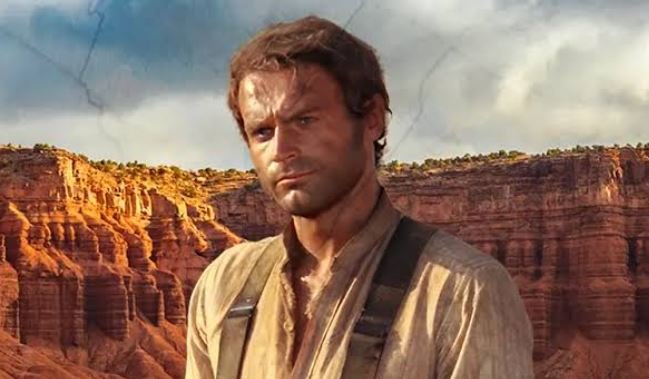
Story & Plot
The story centers on Trinity (Terence Hill), a lazy, easygoing drifter who, despite his unkempt demeanor, possesses uncanny speed and precision with a revolver. Known as “The Right Hand of the Devil,” he enters a dusty town resting on a horse-drawn travois. There, he stumbles upon his elder brother, Bambino (Bud Spencer), famously known as “The Left Hand of the Devil.”
Bambino, an escaped horse thief, has ambushed the town’s legitimate sheriff on his way to take office and assumed his identity, complete with the badge. Though Bambino is thoroughly annoyed by his troublemaking brother’s arrival, the duo is forced to join forces against the greedy local landowner, Major Harriman (Farley Granger).
Major Harriman seeks to drive away a peaceful community of Mormon settlers occupying a fertile valley so he can use the land to graze his valuable, unbranded horses. Bambino initially agrees to help Trinity solely out of self-interest—hoping to steal the Major’s horses for himself. However, Trinity, having fallen for two charming Mormon sisters, genuinely commits to protecting the peaceful community.
Trinity and Bambino proceed to teach the non-violent Mormons the art of hand-to-hand brawling and dirty fighting tricks. During the climax, citing the Biblical passage that “there is a time for fighting,” the Mormons unleash their newfound skills and overpower the Major’s henchmen. In the aftermath, Bambino is enraged to discover that Trinity has branded all the Major’s horses with the Mormons’ mark, legally handing the herd over to the settlers. Fearing a life bound by strict discipline, hard labor, and constant prayer with the Mormons, Trinity slips away to continue his carefree adventures.
Casting & Performances
- Terence Hill (Trinity): Terence Hill portrays “The Right Hand of the Devil” with impeccable comic timing and charm. His dusty, lazy appearance juxtaposed with lightning-fast gun-drawing skills delivers an absolute mass-appeal experience on screen. (To film the iconic bean-eating scene in a single take, Hill famously fasted for 24 hours).
- Bud Spencer (Bambino): As “The Left Hand of the Devil,” Bud Spencer’s towering physical presence, stern expressions, and quick-tempered reactions to his brother’s antics provide the core comedy of the movie. His signature heavy overhead wallops and punches garnered immense laughter in theaters worldwide.
- Farley Granger (Major Harriman): Hollywood actor Farley Granger delivers a refined and suitably arrogant performance as the primary antagonist.
- Supporting Cast: Steffen Zacharias (Jonathan), Dan Sturkie (Tobias), Gisela Hahn (Sarah), and Elena Pedemonte (Judith) round out the ensemble with memorable supporting roles.
Character Development
The core strength of the film lies in the contrasting dynamics between the two brothers:
- Trinity: On the surface, a shiftless, irresponsible gunman, but underneath lies a strong sense of justice and compassion for the vulnerable. Yet, his innate love for freedom ultimately drives him away from settled life.
- Bambino: A rough, pragmatic outlaw who acts out of self-interest, but behind his gruff exterior lies genuine affection for his brother and a willingness to stand up for the helpless.
- The Mormon Settlers: The transformation of a strictly pacifist group learning to physically stand up for their rights and community adds a unique and satisfying arc to the narrative.
Production & Music
- Production Details: Interiors and town sets were filmed at Rome’s Incir De Paolis Studios, while the breathtaking valley landscapes were shot in Campo Imperatore, Abruzzo, Italy.
- Music & Score: The iconic theme song “Trinity: Titoli,” composed by Franco Micalizzi and Lally Stott and sung by Annibale Giannarelli, became an international hit. (Years later, director Quentin Tarantino famously used this track as the closing theme for his 2012 Western, Django Unchained).
Verdict & Legacy
By reinventing the grim Spaghetti Western format into an action-comedy masterpiece, ‘They Call Me Trinity’ spawned an entire sub-genre. Decades after its release, it remains an enduring favorite among classic cinema enthusiasts worldwide.
For more details: Navamalayalam.com